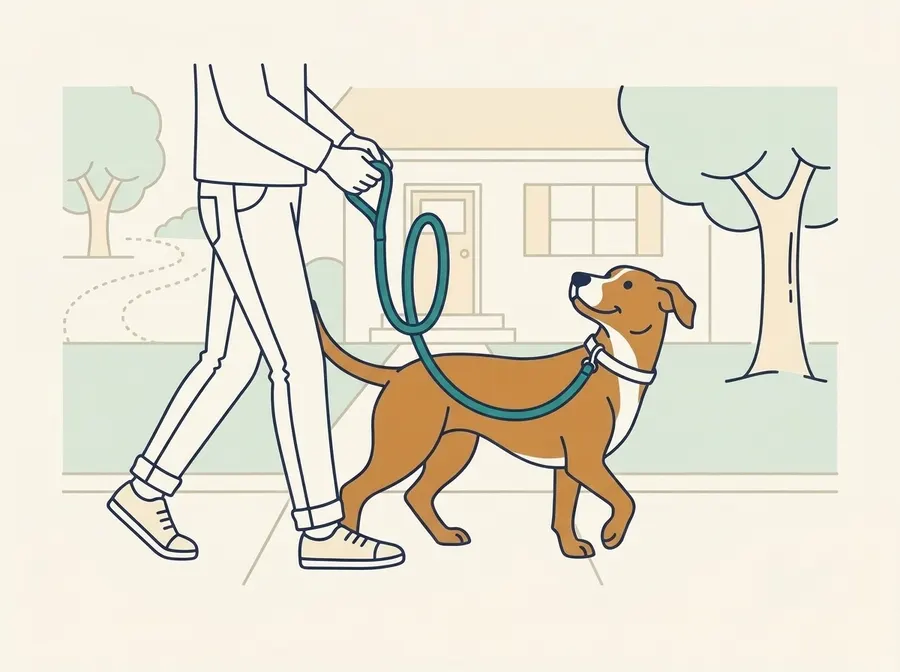
Please read this first. You told us your dog has bitten or tried to bite. This program isn't the right first step for your dog. Start with in-person help from a qualified trainer or behavior professional, and with your vet if anything changed suddenly or your dog might be in pain. The page below is here if you still want to read about the program.

Below is what your answers showed, the lesson on your dog's plan that handles each one, and the 14-lesson order that starts in your living room and climbs to the Real Walk, one rung at a time.
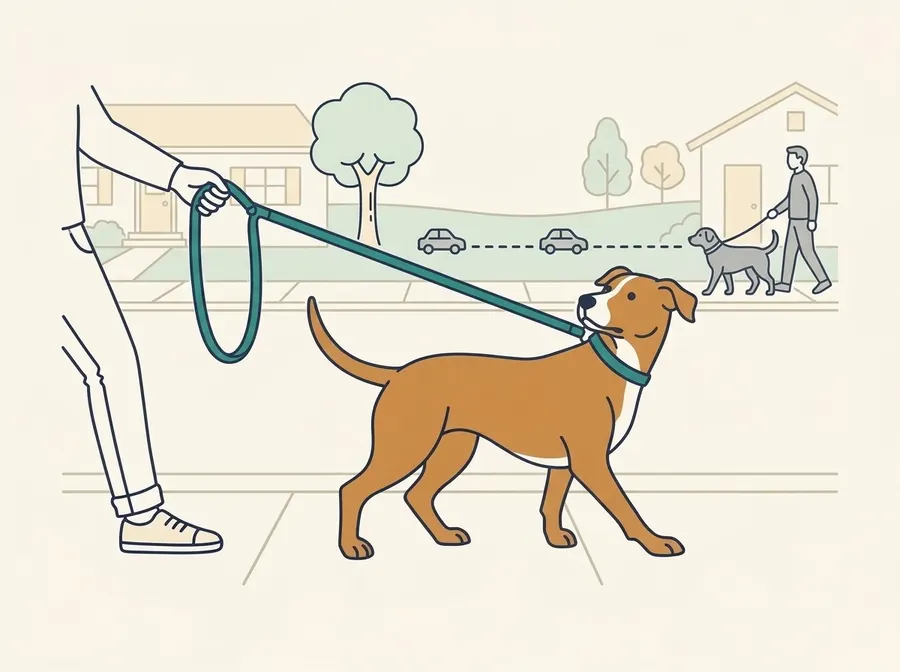
Your answers point to the Reacts track: distance, an exit, and a reset, practiced in order and starting at home. Below is what your answers showed and the lesson that handles each one.


Your answers point to the Both track: the leash and the encounters, worked on in one order, starting at home. Below is what your answers showed and the lesson that handles each one.

Neither index reached 4, so your plan is the Pulls track as a tune-up: 14 lessons that start at home and tighten the parts of the walk that still slip. Below is what your answers showed and the lesson that handles each one.
Neither index reached 4, so your plan is 14 lessons that start in your living room and climb to the Real Walk, one rung at a time. Below is what your answers showed and the lesson that handles each one.
We couldn't find your quiz result. It only takes 14 questions to get it back.
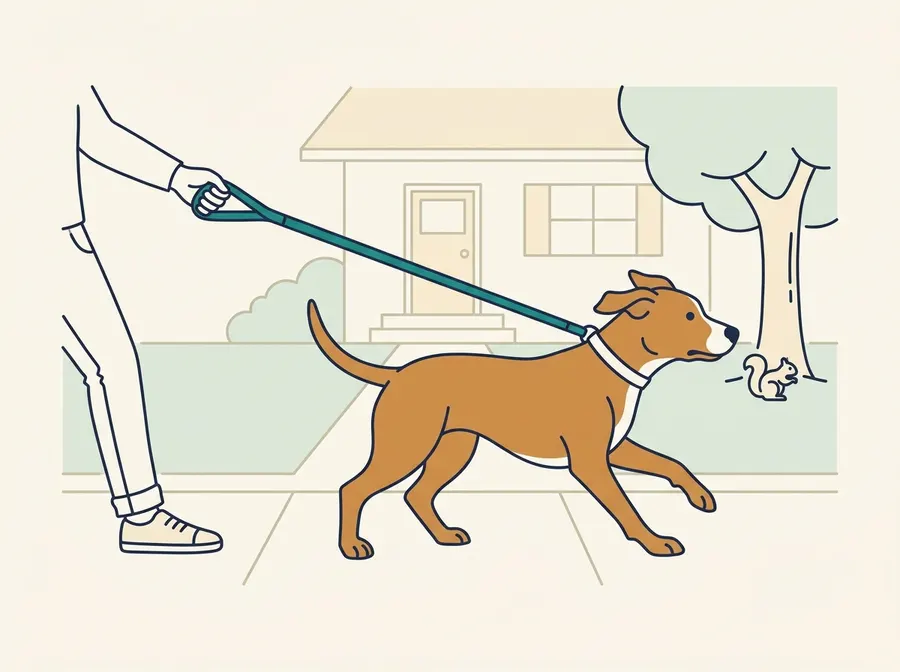
This page is built around your quiz result. Take the 14-question Walk Quiz first, and it will open on your dog's track.
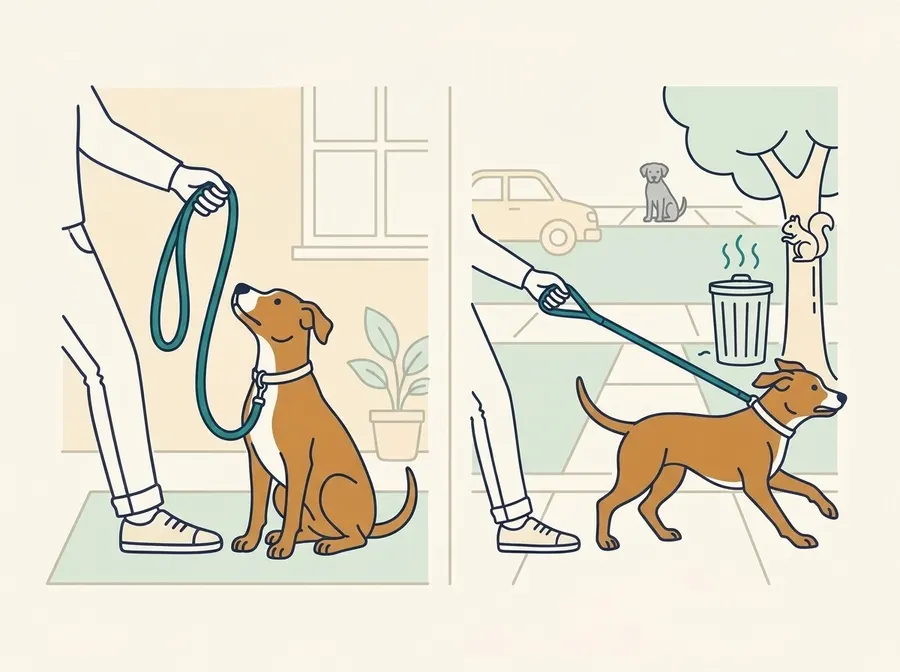
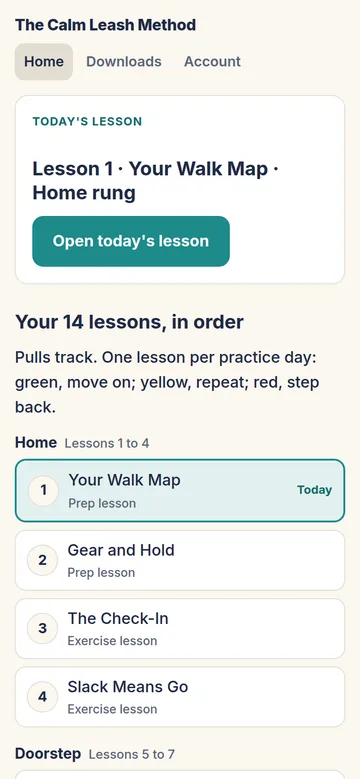
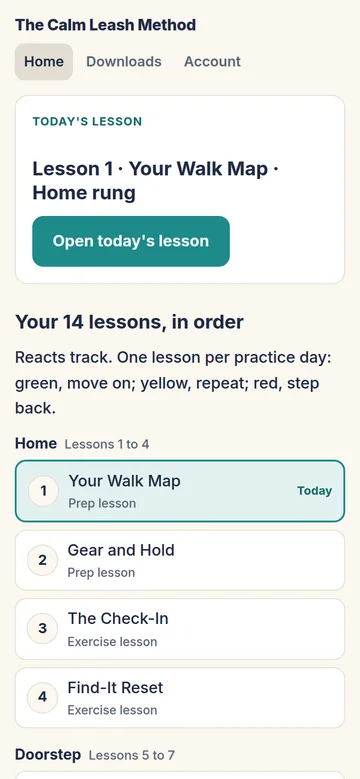
One lesson per practice day. The lessons are what you get when you join; here's the order your answers picked.

Think about where your dog practices walking on a leash. On the walk.
That's the problem. Most walks start on the hardest rung there is: the street, full of smells, dogs, noise, and squirrels. Your dog is asked to do out there what they've never practiced in your living room.
And every time pulling gets your dog where they want to go, they get a little more practice at pulling.
Reacting has its own version of this. When another dog is closer than your dog can handle, your dog can't learn anything in that moment. They can only react. So each close call teaches nothing new, and the next one starts from the same place.
Before you decide your dog is just stubborn, or that you're doing something wrong, look at where the practice has been happening: on the hardest rung, with no rule for when to move up.
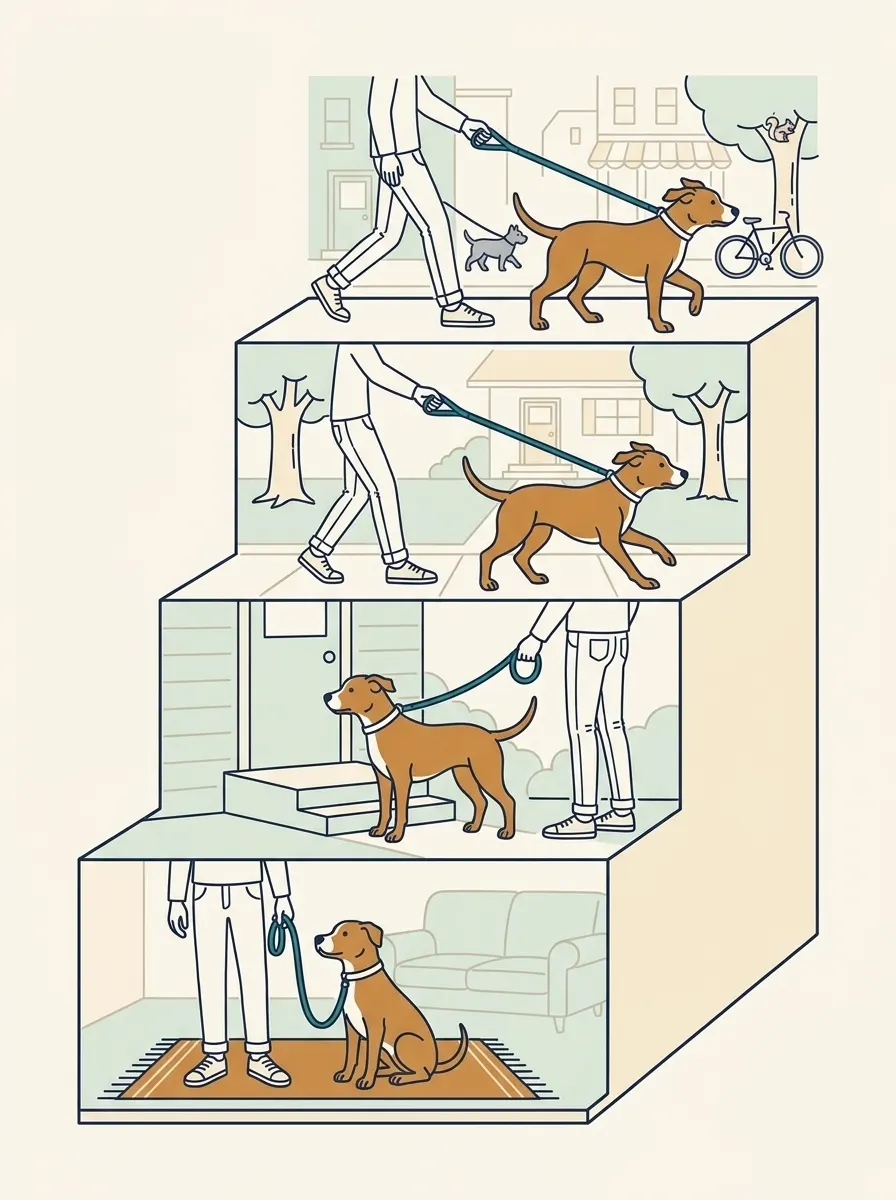
It starts with the Walk Ladder: practice where it's easy, climb one rung at a time, and let the Three-Light Rule tell you when.

The Walk Ladder has four rungs. Every lesson sits on one of them, and you only climb when the day's test says you're ready.
A skill practiced on the Home rung goes out the door with you, then down the Quiet Block, then onto the Real Walk. If it slips on the way, you step back a lesson, and that's part of the plan, not a failure.
Which raises the real question: how do you know when to climb?
Every practice day ends the same way. At the end of your last session, you do 5 reps of the day's exercise and count how many went right. (Prep lessons have a short task list instead.) Then you read your light.
4 or 5 of the 5 reps went right, and there was no barking or lunging that day. For prep lessons: task list complete.
Tomorrow: the next lesson.
2 or 3 of the 5 went right. On the Reacts and Both tracks, a yellow is also a day when your dog went stiff or stared, then recovered once you moved away. For prep lessons: task list not finished.
Tomorrow: repeat the same lesson. Three yellows in a row on one lesson count as a red.
0 or 1 of the 5 went right, or there was any barking or lunging.
Tomorrow: step back to the previous exercise lesson on your track. On the Reacts and Both tracks, a red from barking or lunging makes tomorrow a calm day first: the Find-It Reset and a short walk, with no test. Then you step back. Prep lessons never get a red.
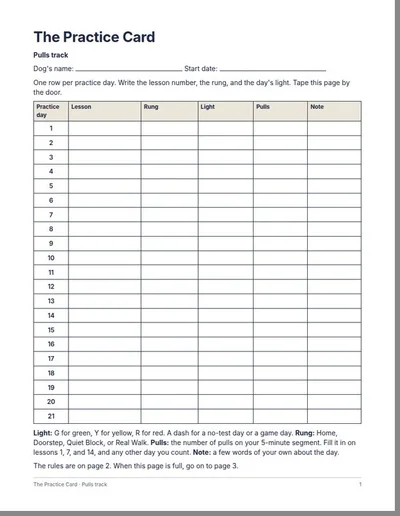
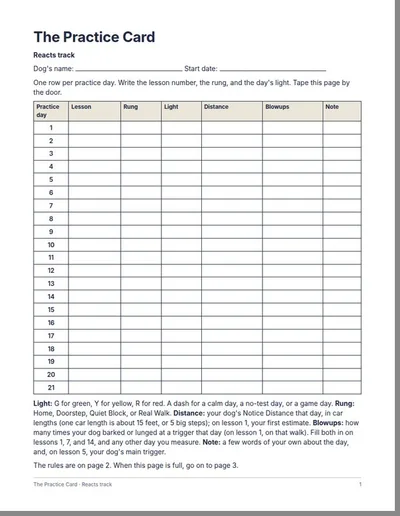
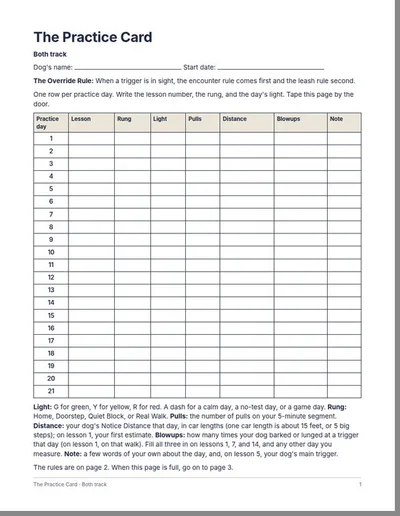
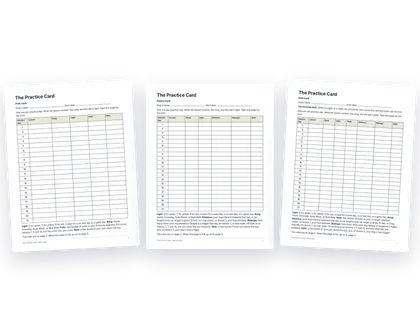
You mark each practice day on your Practice Card, which prints out and goes by the door. Here's a worked example from the Pulls track. It's printed on page 2 of your card, so you never have to work out the rules on your own.
| Practice day | Lesson | Rung | Light | Tomorrow |
|---|---|---|---|---|
| 1 | 1. Your Walk Map | Home | Green | Lesson 2 |
| 2 | 2. Gear and Hold | Home | Green | Lesson 3 |
| 3 | 3. The Check-In | Home | Yellow | Repeat lesson 3 |
| 4 | 3. The Check-In | Home | Green | Lesson 4 |
| 5 | 4. Slack Means Go | Home | Green | Lesson 5 |
| 6 | 5. The Door Routine | Doorstep | Red | Back to lesson 4 |
| 7 | 4. Slack Means Go | Home | Green | Lesson 5 |
| 8 | 5. The Door Routine | Doorstep | Green | Lesson 6 |
Day 6 was a red, so day 7 stepped back to lesson 4. A green there sent day 8 straight back to lesson 5. Nothing to guess.
That's also why we call them practice days, not days. 14 lessons is 14 practice days only if every day is green. Yellows and reds make the plan run longer, and the card keeps count.
Your card also has a measure for your track, taken on lessons 1, 7, and 14: pulls on the same 5-minute stretch for Pulls; the distance where your dog notices a trigger (in car lengths) and blowups per walk for Reacts; all three for Both. So your card shows you, in your own numbers, whether the walk is changing.
Here's what your answer actually changes.
Here's what your track actually changes.
| Pulls | Reacts | Both | |
|---|---|---|---|
| Lessons beyond the 6 shared ones | 8 pulling lessons | 8 reacting lessons | 3 pulling, 3 reacting, and 2 of its own |
| What you measure on lessons 1, 7, and 14 | Pulls on the same 5-minute stretch | Notice Distance in car lengths, and blowups per walk | All three |
| Your Practice Card columns | Pulls | Distance and blowups | All three, with the Override Rule at the top |
| Your Field Guide chapter | Loose leash, the door, pace, sniffing as pay | Distance, exits, the reset, your route | The Override Rule and the mixed walk |
The program has 24 lessons: 6 that every track shares, 8 for pulling, 8 for reacting, and 2 for dogs who do both. Your track uses 14 of them. Pulls and Reacts share the 6 and differ in the other 8. Both keeps the 6 shared lessons, takes 3 from each side, and adds 2 of its own, including the Override Rule.
Got a result that doesn't sound like your dog? One button in your member area switches tracks. Your lessons reorder and you get the Field Guide and Practice Card for the new track. No new purchase. All 24 lessons stay open to you that way.
Lesson 3, The Check-In, is on every track. Below is an excerpt, word for word from the program: the goal, why today, the five steps, the "If this happens" box, and the test from the Card check. Left out here: where to practice, what you need, the reps and minutes box, the Short day version, and the end of the Card check, where you give the day its light.
Goal: Pay your dog for every look at your face that they offer on their own, so that checking in with you gets practiced many times a day.
Everything after this lesson starts with the same small moment: your dog looks at you. On the street, that look is what lets you turn, slow down, or move away from something together. Your dog has had very little practice at it with a leash on, so you begin where it is easiest: indoors, with nothing else going on.
You are not going to call your dog or ask for the look. You wait for it, and you pay for it. A look they offer on their own is the one you can use later, when you have no hand free to get their attention. That is also why the treats stay out of sight until the look has happened.
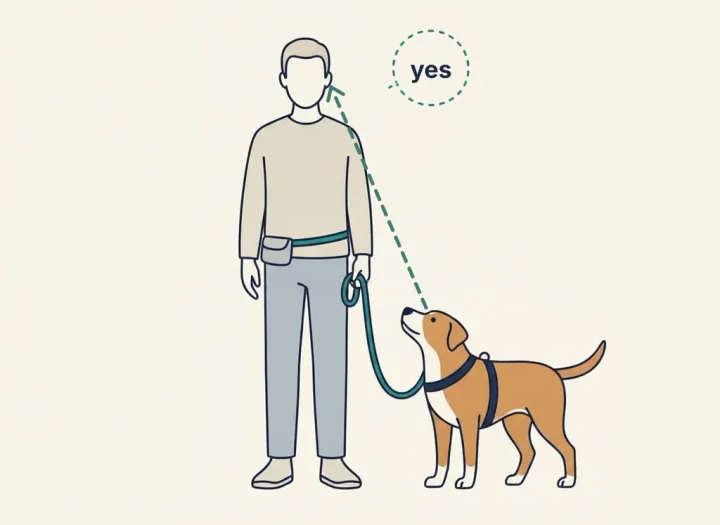
Today you also start using one word: "yes". You say it at the instant your dog gets it right, and a reward follows every "yes". From here on, "yes" tells your dog exactly which moment earned the reward.
This is the first lesson with a 5-rep test. Keep it easy and keep it short.

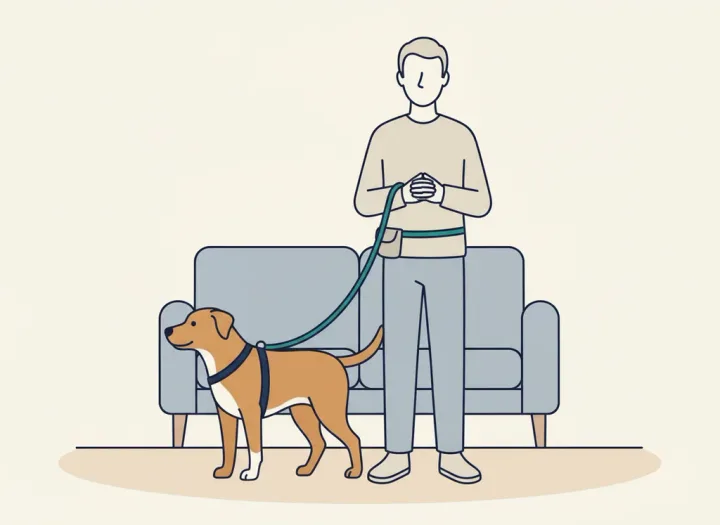
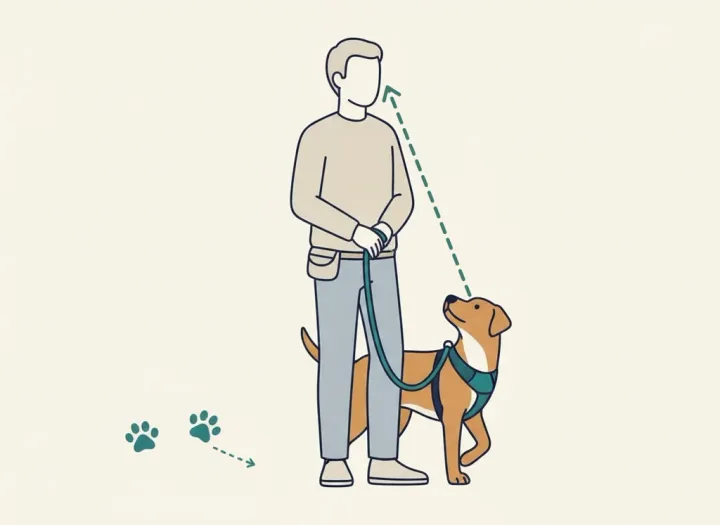
Stand still in your quiet spot with your dog on leash, hands at your center. Say nothing. Don't call, don't point, and don't show a treat.

Wait. The moment your dog's eyes come up to your face, say "yes".

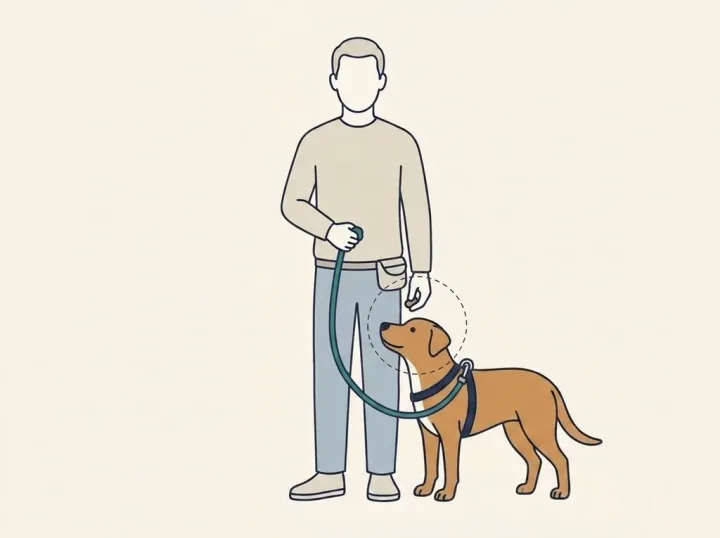
Give one treat at your leg: at the seam of your pants, on your dog's side, at the height of their nose.

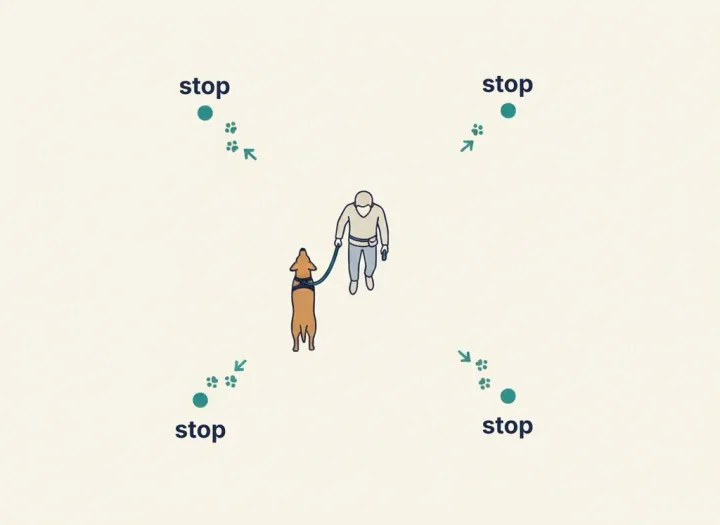
Take two slow steps and stop. Wait again. When your dog looks at your face, say "yes", then give a treat at your leg.

Repeat: two steps, stop, wait for the look, "yes", treat. Change direction each time, so your dog finds you in a new place.
Your dog stares at the treat pouch or your hand, not your face. Keep your hands at your center and wait. Pay only when their eyes reach your face. If your dog stays stuck on the pouch, turn it to the side away from them for this session.
Your dog never looks up, and sniffs the floor or pulls toward the door instead. The room is still too busy today. Use the easier setup: sit on a chair in a smaller room, leash off, with a softer, smellier treat kept out of sight, and count a look at your face within 10 seconds as right. Practice that way today and tomorrow.
Your dog jumps up on you after the "yes". Bring the treat down faster and lower, at the seam of your pants, so that your dog eats with four paws on the floor. Wait for four paws before you take your next two steps.
Today's test: At the end of your last session, do 5 reps and count the ones that go right.
A rep counts as right when: you take two steps and stop, and your dog looks at your face within 5 seconds, without you calling them or showing a treat.
Every exercise lesson in the program follows the same pattern: the goal, where to practice, what you need, why today, the steps in pictures, a reps and minutes box, a Short day version for busy days, "If this happens", and the Card check. Prep lessons swap the test for a short task list.

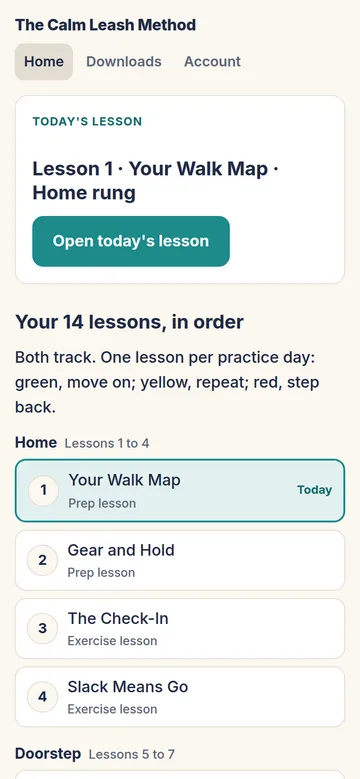
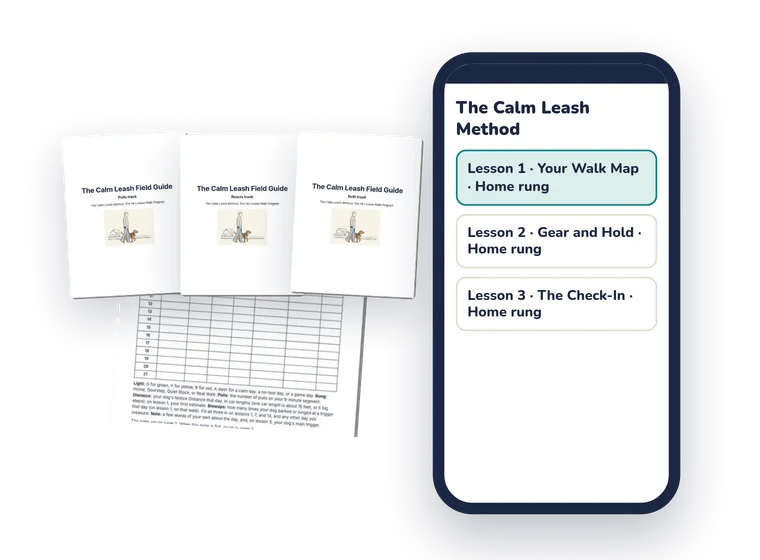
Your track's 14 lessons, one per practice day, on the Walk Ladder from Home to Real Walk. Each one is illustrated step by step and ends with the day's Card check. Your member area opens on the track your quiz picked.
Your track's 14 lessons, one per practice day, on the Walk Ladder from Home to Real Walk. Each one is illustrated step by step and ends with the day's Card check. When you open your member area, it asks the 5 quiz questions that set your track, then opens at lesson 1.
A 30-page printable PDF for your track. Prints in black and white on US letter paper. How to use the program, the Walk Ladder, the Three-Light Rule, gear and how to hold the leash, rewards, the core exercises one per page, your track's chapter, a problem-and-answer table, and when to get in-person help. Keep it by the door or on your phone.
A 3-page printable PDF for your track: the grid you mark every practice day, the rules with the worked example, and a continuation grid for when your plan runs longer. It tells you after every practice day whether to move on, repeat, or step back.
If your result doesn't describe your dog, one button switches tracks and reorders everything. No new purchase.
[email protected]. We reply within 2 business days.

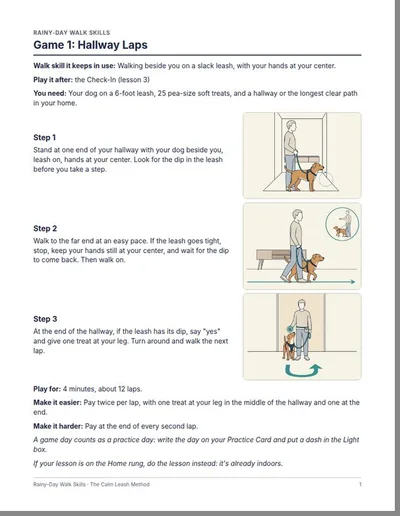
6 indoor games, one per page: a 6-page PDF plus a web page in your member area. For the days a walk isn't happening, so practice still happens.
A leash (the lessons use a standard 6-foot one), small treats, and a phone or computer with email. A printer helps but isn't required.
Then it's on you to practice, run the day's test, mark the card, and follow the light. Lessons 1 to 4 are practiced at home, so you can start the day you join. The one thing that needs a walk is your first measurement in lesson 1, taken on a regular walk, today's or your next one.
This is not a video course. There are no videos of real dogs, no trainer on call, and no community. You get illustrated lessons, printable PDFs, and email support.
Please read this first. You told us your dog has bitten or tried to bite. This program isn't the right first step for your dog. Start with in-person help from a qualified trainer or behavior professional, and with your vet if anything changed suddenly or your dog might be in pain. The page below is here if you still want to read about the program.

The Calm Leash Method: The 14-Lesson Walk Program
$67, one-time payment
No subscription. Nothing renews.
30-Day Money-Back Guarantee: email [email protected] within 30 days of your purchase and get a full refund. No forms. No proof.
Your access link arrives by email right after payment. After checkout, you'll see an optional add-on and, if you pass on it, a smaller one. Each is charged only if you click "Yes, add it". Say no to both and you go straight to your program.
No. The lessons are illustrated, step by step, on web pages you open on your phone or computer, plus printable PDFs. There are no videos of real dogs and no trainer on call. If you have a question, email [email protected] and we reply within 2 business days.
The Calm Leash Method is a step-by-step program built on two tools: the Walk Ladder and the Three-Light Rule. There's no trainer behind it and no promise built on someone else's dog. What you can judge for yourself is on this page: an excerpt from a real lesson, the worked example from the Practice Card, and what changes by track. Questions before you buy? Email [email protected]. We reply within 2 business days.
There's no date we can promise. Your dog, your practice, and your streets all play a part. What the program does promise is the plan: 14 lessons in your track's order, a test at the end of every practice day, and a card that shows you, in your own numbers, whether the walk is changing.
It's 14 lessons. If every day is green, that's 14 practice days. Yellow days repeat a lesson and red days step back, so your plan can run longer, and your Practice Card keeps track.
Each lesson tells you exactly how many reps and sessions to do. If you told the quiz you have about 5 minutes on most days, your lessons open in their Short day version by default.
Switch tracks from your member area. Your lessons reorder and you get the Field Guide and Practice Card for the new track. No new purchase.
Then this program isn't the right first step. Please start with in-person help from a qualified trainer or behavior professional, and with your vet if anything changed suddenly or your dog might be in pain.
No. A standard 6-foot leash and small treats. Lesson 2 covers a flat collar or a front-clip harness and how to hold the leash. No prong, choke, or shock collars. Ever.
Lesson 2 has a "Walking alone" section and an "If walking hurts" section, with a grip and stance that spare your shoulder while you practice.
Plenty of tips are out there. What you're paying for isn't more tips. It's the order, matched to your dog, and a rule for every practice day.
Lifetime access for as long as the program is published. If it's ever retired, you'll get 60 days' notice and a copy to download. PDFs you've downloaded are yours to keep.
30-Day Money-Back Guarantee: email [email protected] within 30 days of your purchase and get a full refund. No forms. No proof. PDFs you've downloaded are yours to keep, even if you ask for a refund.
No. It's $67, one-time payment. No subscription. After checkout you'll see an optional add-on and, if you pass on it, a smaller one. Each is charged only if you click "Yes, add it". Say no to both and you go straight to your program.
Yes. Lessons 1 to 4 are practiced at home (your first measurement is taken on a regular walk, today's or your next one), and the Rainy-Day Walk Skills bonus has 6 indoor games for days without a walk.
Your access link arrives by email right after payment. Your member area opens on the track your quiz picked, starting with lesson 1.
Your access link arrives by email right after payment. When you open your member area, it asks the 5 quiz questions that set your track, then opens at lesson 1.

You can keep walking your dog the way you have been. That's a real option, and it costs nothing today.
Or tonight, at home, you can open lesson 1, set up your Practice Card, and know exactly what tomorrow's practice is. Then the card tells you, after every practice day, whether to move on, repeat, or step back.
If it isn't for you, one email within 30 days gets your money back.
$67, one-time payment · 30-Day Money-Back Guarantee
P.S. Your result is saved. When you join, your member area opens on the track, at lesson 1. And if the track ever feels wrong for your dog, one button switches it.
P.S. When you join and open your member area, it asks the 5 quiz questions that set your track, then opens at lesson 1. And if the track ever feels wrong for your dog, one button switches it.